
What are Project Management Skills for 2024 in the UK?

In the UK, many handle projects, but what are project management skills that can set you apart?
To truly stand out and achieve meaningful results in 2024, there's a need to hone specific
project management abilities. Discover the essential skills a proficient project manager
requires in today's fast-paced environment and learn how to enhance them.
If you are in charge of projects, no matter what your job title is, you are acting as a project
manager. Teams are looking for people like you to lead them because teamwork is so important to
success in the workplace of 2024.
But there's always room for growth, even if you're already handling various projects. So, what
can you do to improve your project management skills in the UK right now? It's good that you
want to be perfect.
This guide is made for people like you who want to do well in the busy world of project
management in 2024. We'll show you important skills that will put you ahead of the pack, whether
you're a project manager or a leader.
We'll also show you the best places and ways to improve these skills in the UK, so you can stay
ahead of the game.
Project management skills
Since the world of project management is changing quickly, you need more than just the basics. Here's how you can really get out:
- Emotional intelligence (EQ)
- Conflict resolution
- Continuous learning
- Managing stakeholders
- Negotiation skills
- Cultural awareness
- Feedback is your growth catalyst
Let's say that during a few team meetings, you notice that one of the
people there, seems a little shy. You go up to him during a break to encourage him and
give him personal advice. You can improve the team's cohesion and morale by listening to
their worries and showing that you understand them.
EQ is important whether you want to be a project manager, a junior project
manager, or taking courses on project management. Understanding and managing the
emotional dynamics of a team can change the game. It's your secret tool for making
friends and bringing the team together.
Two of your team members seem to have different ideas about how to do
a project. Instead of letting the tension build up, you decide to step in and help find
a solution that works for both tactics.
As you climb the project management ladder, you will run into problems. Mastering the
techniques of conflict negotiation makes sure that your team stays together and shows
that you can handle challenging situations on the job.
In the business world, new methods and tactics come up all the time.
On the basis of an idea, you decide to take a short course to improve your skills.
Later, you use this new information, which makes the job run more smoothly.
The best project managers are always getting better at what they do. Use a strategy of
constant learning to stay ahead. Whether it's the latest technology or methods, staying
up to date will make you stand out as a job candidate or in your studies.
In the middle of a big project, one of the people who have a stake in
it starts to worry. You don't just brush it off. Instead, you carefully deal with each
problem, making sure that the people involved feel valuable and sure of the project's
direction.
As part of your job, you will often have to talk to stakeholders. Learning to manage and
go above and beyond their standards is important and says a lot about how well you can
handle your responsibilities. Informed Decision-making get the skills you need to make
quick choices based on facts. It's a very useful skill, especially when working on
important projects or learning.
One of our normal suppliers is running late. You quickly move your
resources in a different direction after remembering an option you had considered
before. This keeps any delays from happening. A team suggests a short time frame.
Knowing what this means, you try to negotiate a more realistic time frame by explaining
why a slightly longer plan is better for quality.
Your ability to negotiate can make a big difference when it comes to resources,
deadlines, and budgets. It shows how well you can balance and match different things.
When organising, you can make sure that no important cultural events
are missed by having a team with people from different backgrounds. This easy step makes
sure that everyone feels like they belong.
As businesses go global, knowing cultural differences can give you an edge, especially
if you want to work for a multinational company or on a global project.
After showing a sketch of a project, people have different things to
say about it. You don't let it get you down. Instead, you use it to improve the end
result and make it better than anyone expected.
Accept criticism. Think of it as a chance to grow, whether you're a student getting
feedback on your work or an aspiring project manager getting advice from coworkers.
It shows you where you can improve so that your path to project
management success doesn't get blocked. You'll need both technical knowledge and these
important soft skills to become a great project manager.
Whether you're already on the path or just starting out, remember to be flexible, eager to
learn, and always on the move.
These qualities will not only help you do well in your courses, but they will also make you
a desirable candidate for jobs in project management.
Soft skills in project management
In project management, "soft skills" are the non-technical,
interpersonal, and communication skills that help a project manager lead, influence,
communicate with, and motivate a diverse team.
These skills are important for making sure that a job goes smoothly from the beginning to
the end. They make sure that human factors like team dynamics, stakeholder standards, and
conflict resolution are handled well.
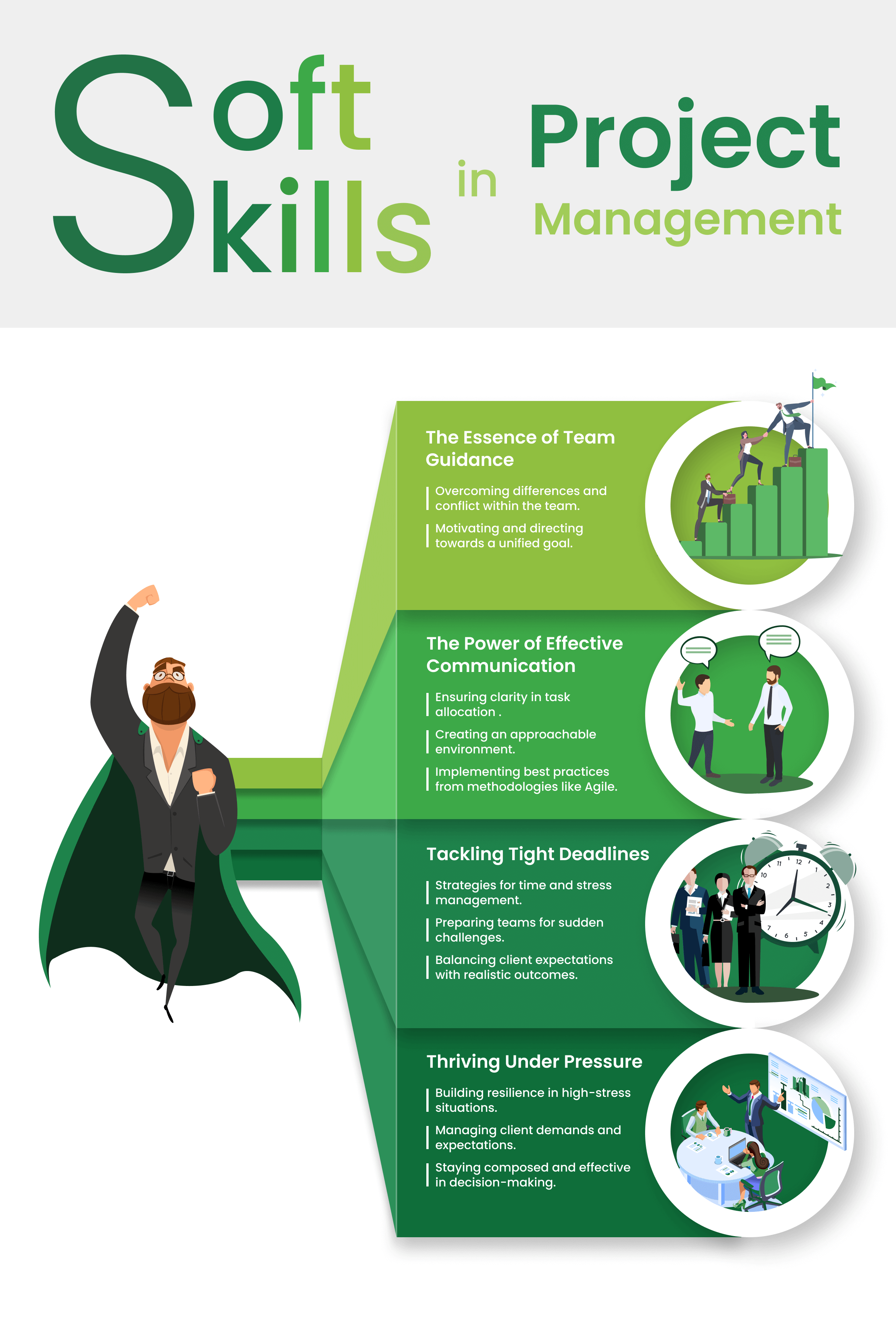
- Be a good leader
- Practise effective communication
- Meeting almost impossible deadlines
- Surviving under pressure
Leading means guiding and motivating a group of people to work towards a shared goal, knowing the strengths and weaknesses of each person, and making sure the group works well together.
This includes not only talking or writing but also listening and figuring out what people are trying to say without saying it. Effective communication makes sure that everyone is on the same page about the goals of the project.
Meeting goals that are almost impossible to meet takes good time management, stress management, and the ability to change. A project manager needs to be able to get things done quickly, set priorities, and adapt to changes or problems that come up out of the blue.
To do this, you need to be strong and know how to deal with worry. It's important to be able to stay calm under pressure, think clearly, and make good choices, even when problems come up.
Technical skills in project management
Technical skills, on the other hand, are more concrete and have to do
with the real operations of managing a project. Soft skills, on the other hand, are
interpersonal and have to do with behaviour.
Most of the time, they are specific to the field of project management or the business in
which a project is being done, and they can be taught in school.
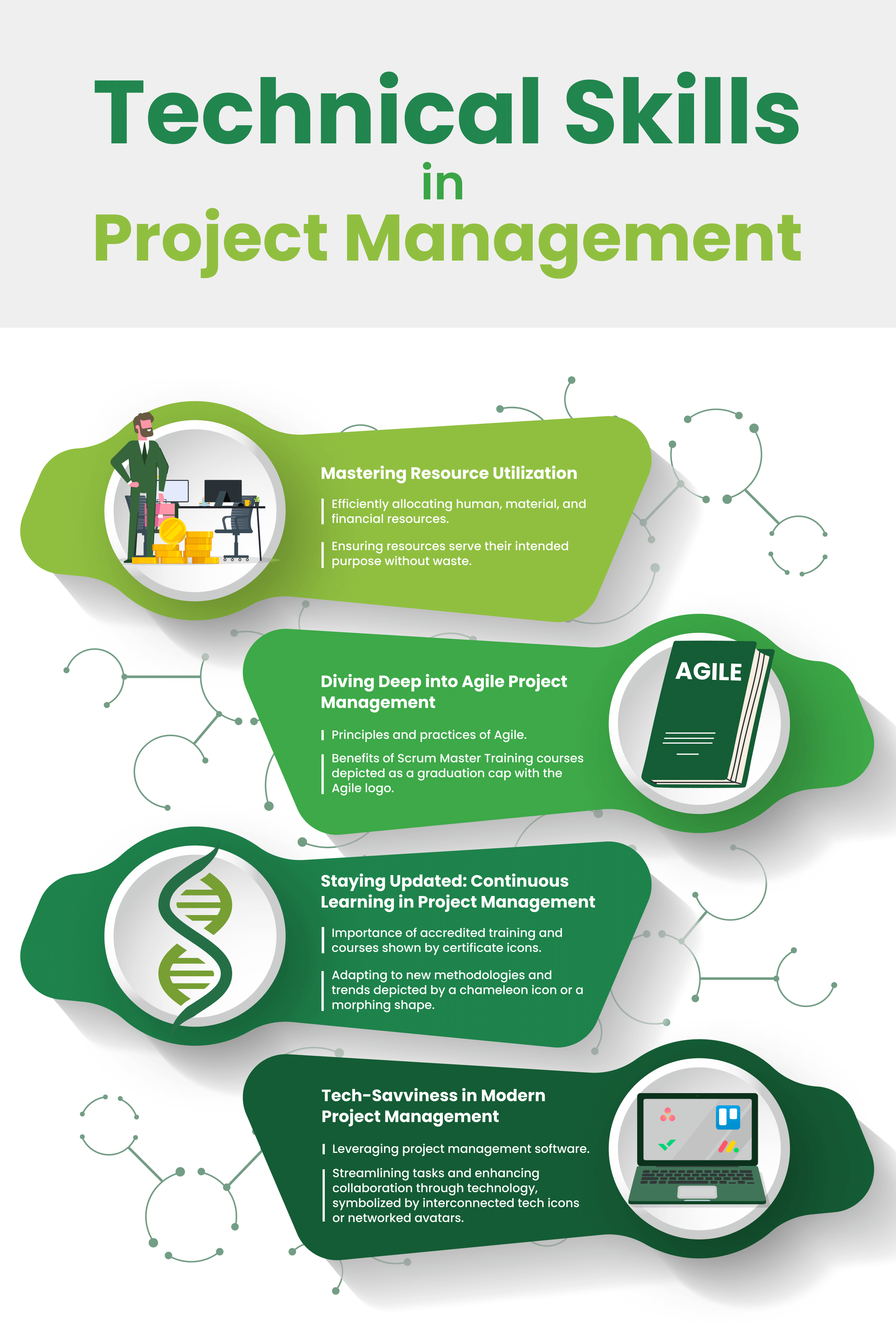
- Resource management
- Agile project management
- Keeping updated
- Being tech-savvy
Resource management is the process of allocating resources (human, material, or financial) in the best way possible to make sure a job is completed successfully.
Agile is a way of managing projects that has its own rules, practises, and frameworks, like Scrum and Kanban.
This means that you have to keep learning and getting better at your job. A project manager should know about the most up-to-date tools, techniques, and methods for managing projects.
Being tech-savvy means you know how to use apps and tools for project management. Microsoft Project, Trello, Jira, and Asana are some examples. Using these tools can speed up tasks, make it easier for people to work together, and improve the general efficiency of a project.
Academic skills in project management
Academic skills and knowledge in project management refer to the theoretical and fundamental understanding of project management ideas. Most people get these skills through formal education, certifications, and academic study. They give a strong foundation for using both professional skills and soft skills in real-world project situations.
- Foundational principles in the UK
- Theoretical methods and approaches
- Research and analysis
- Ethics in project management
- Strategic alignment and business knowledge
- Certifications and standards in the UK
Find out how some of the most important project management concepts are used in the UK. Learn about the important organisations and groups and the impact of the British Standards on time and scope management that make project management in the UK unique.
Learn about the most common methods used in the UK, from the well-known PRINCE2 to modified versions of Agile and Waterfall. Find out how the lean method is catching on in different fields.
Learn about the best institutions and study resources in the UK that help with project management. Look at UK-focused case studies and figure out the important research trends that are affecting the world scene.
Learn about the ethical situation of project management in the UK. Learn how to handle real-life ethical problems and how local associations support and promote best practises.
In the UK's unique business environment, it's important to look at how projects fit into company strategies and national economic goals. Learn how different business models interact with project goals.
Learn about the most popular titles in the UK, such as PMP, CAPM, and especially PRINCE2. Find out how important the British Standards Institution is when it comes to setting and maintaining project management standards.

Key takeaways
In the always-changing world of project management, especially as we move towards 2024, your success depends on how well you can use your skills and adapt to change. Here's what we found out:
- EQ is not just a buzzword for emotional intelligence. It's your main way to figure out how your team works and bring everyone together.
- Being able to negotiate and settle disagreements is important for keeping a project going and keeping the team happy.
- The business world is always changing. It's not just important to keep up with the latest trends and methods—it's essential.
- Each partner is important. Taking care of their worries and managing their demands can make or break the success of your project.
- Quick and good choices, along with good negotiation skills, make the best use of resources and time.
- As businesses grow around the world, it's important to understand the differences between cultures.
- Using comments as a way to improve also pushes you to do better.
Soft skills are important, but knowing the basics and technical side of project management is still the most important part of your job. No matter how long you've been running projects, there's always more to learn. Because the business environment in the UK is unique, adapting your skills to its needs can give you an edge that no one else can match.
Are you ready for the next step?
Accredited courses can help you learn how to handle projects better. Get the information and credentials that can help you move up in your career.
FAQs
In 2024, technological advances, business practise changes, and the UK business
environment will dramatically change project management. Updating your project
management skills helps you succeed and adapt to this changing environment. Are
you ready to stay ahead? Join our courses now.
PRINCE2 (Projects in Controlled Environments) emphasises project control
throughout its lifecycle. Agile accommodates changes and promotes flexibility.
One may be better for your projects. Want a deep dive? Our
PRINCE2 Foundation
and PRINCE2 Agile
Foundation Course with Official Exam courses provide
in-depth knowledge.
Absolutely. Project managers can comprehend, interact with, and manage their
teams using EQ. Managers with greater EQ can better manage team dynamics,
resulting in more cohesive, motivated teams and successful initiatives. Improve
your EQ and management abilities with our expert-tailored training.
The project management world evolves. Certifications verify your knowledge and
keep you current on methods, tools, and best practises. Additional credentials
can help you stand out in the UK's competitive job market. Courses like
MSP
Foundation and MSP Practitioner can help you upgrade your
certifications
immediately.
The UK has unique corporate, economic, and cultural practises. Project managers
who grasp these characteristics can better connect initiatives with local
business goals, overcome problems, and satisfy stakeholders. Join our different
courses for UK-specific insights. Ready to grow your UK project management
career? Dive into our courses and lead the field!
Related Products
Leave a Message
Leave a Message
YOUR EMAIL ADDRESS WILL NOT BE PUBLISHED. REQUIRED FIELDS ARE MARKED.